Print Friendly Version of this pagePrint Get a PDF version of this webpagePDF

Monday, 23 December 2013

Fabric and garment finishing : Basic washes in denim fabric

THE HISTORY OF DENIMS:
A popular conception of the etymology of the word denim is that it is a contraction or derivative of the French term, serge de Nmes. Denim was traditionally colored blue with indigo dye to make blue “jeans,” though “jean” then denoted a different, lighter cotton textile; the contemporary use of jean comes from the French word for Genoa, Italy (Gnes), from which the first denim trousers were made.
A similarly woven traditional American cotton textile is the diagonal warp-striped hickory cloth that was once associated with railroad mens overalls, in which blue or black contrasting with undyed white threads form the woven pattern. Hickory cloth was characterized as being as rugged as hickory woodnot to mention the fact that it was deemed to be worn mainly by “hicks”although neither may be the origin of that term [from a nickname for "Richard"]. Records of a group of New Yorkers headed for the California gold fields in 1849 show that they took along four “hickory shirts” apiece. Hickory cloth would later furnish the material for some “fatigue” pantaloons and shirts in the American Civil War.
clip_image001
INTRODUCTION:
Denim is a rugged cotton twill textile, in which the weft passes under two (twi- “double”) or more warp fibers, producing the familiar diagonal ribbing identifiable on the reverse of the fabric.
DENIM WASHING:
Denim washing is the aesthetic finish given to the denim fabric to enhance the appeal and to provide strength.
Dry denim, as opposed to washed denim, is a denim fabric that is not washed after being dyed during its production.
Much of the appeal of dry denim lies in the fact that with time the fabric will fade in a manner similar to that which artificially distressed denim attempts to replicate. With dry denim, however, such fading is affected by the body of the person who wears the jeans and the activities of their daily life. This creates what many feel to be a more natural, unique look than pre-distressed denim.
clip_image002
DENIM WASHES ARE OF TWO TYPES:
clip_image0031. Mechanical washes
  • Stone wash
  • Microsanding
2. Chemical washes
  • Denim bleaching
  • Enzyme wash
  • Acid wash
CHEMICAL WASHES
Denim bleach
In this process a strong oxidative bleaching agent such as sodium hypochlorite or KMnO4 is added during the washing with or without stone addition.
Discoloration produced is usually more apparent depending on strength of the bleach liquor quantity, temperature and treatment time.
It is preferable to have strong bleach with short treatment time.
Care should be taken for the bleached goods so that they should be adequately antichlored or after washed with peroxide to minimize yellowing. Materials should be carefully sorted before processing for color uniformity.
clip_image004
Process cycle:
clip_image005
Limitations:
- Process is difficult to control i.e. difficult to reach the same level of bleaching in repeated runs.
  • When desired level of bleaching reached the time span available to stop the bleaching is very narrow. Due to harshness of chemical, it may cause damage to cellulose resulting in severe strength losses and/or breaks or pinholes at the seam, pocket, etc.
  • Harmful to human health and causes corrosion to stainless steel.
  • Required antichlor treatment.
Problem of yellowing is very frequent due to residual chlorine.
Chlorinated organic substances occur as abundant products in bleaching, and pass into the effluent where they cause severe environmental pollution.
EnzymeWash
It is environmentally friendly wash. It involves the Application of organic enzymes that eat away at the fabric, i.e. the cellulose.
When the desired color is achieved, the enzymes can be stopped by changing the alkalinity of the bath or its temperature. Post treatment includes final rinsing and softening cycle. The effects produced by the cellulose enzyme are—
  1. Use of cellulase making the seams, hems, and pockets more noticeable
  2. Salt pepper effect is color contrast effect.
  3. Faded garment with acid cellulase enzyme provides less color contrast in proportion to garment washed with neutral cellulase enzymes.
Garment load size of the machine is 35-40 jeans per machine and it cannot be overloaded.
clip_image006
Acid wash
It is done by tumbling the garments with pumice stones presoaked in a solution of sodium hypochlorite or potassium permanganate for localized bleaching resulting in a non uniform sharp blue/white contrast.
In this wash the color contrast of the denim fabric can be enhanced by optical brightening. The advantage of this process is that it saves water as addition of water is not required.
Process cycle
clip_image007
clip_image008
Limitations of acid wash:
- Acid washed, indigo dyed denim has a tendency to yellow after wet processing.
- The major cause is residual manganese due to incomplete neutralization, washing or rinsing.
Remedy:
  • Manganese is effectively removed during laundering with addition of ethelene-diamine-tetra-acetic acid as chelating agent.
  • Acid washing jeans avoided some of problems of stone wash, but came with added dangers, expenses, and pollution.
MECHANICAL WASHES
Stone wash:
In the process of stone washing, freshly dyed jeans are loaded into large washing machines and tumbled with pumice stones to achieve a soft hand and desirable look.
Variations in composition, hardness, size shape and porosity make these stones multifunctional. The process is quite expensive and requires high capital investment.
Pumice stones give the additional effect of a faded or worn look as it abrades the surface of the jeans like sandpaper, removing some dye particles from the surfaces of the yarn.
clip_image009
Process cycle:
clip_image010
Selection of stone
Stone should be selected of the proper hardness, shape, and size for the particular end product. It should be noted that large, hard stones last longer and may be suited for heavy weight fabrics only.
Smaller, softer stones would be used for light weight fabrics and more delicate items.
Stone wt. /fabric wt. = 0.5 to 3 /1
It depends on the degree of abrasion needed to achieve the desired result. Stones can be reused until they completely disintegrate or washed down the drain.
clip_image011
Problems caused by stones:
  • Damage to wash machineries and garment due to stone to machine and machine to stone abrasion
  • Increase in labor to remove dust from finished garments.
  • Water pollution during disposal of used liquor.
  • Back staining and re deposition.
Back staining or Re-deposition:
The dye removed from denim material after the treatment with cellulose or by a conventional washing process may cause “back staining or “redeposition. Re-coloration of blue threads and blue coloration of white threads, resulting in less contrast between blue and white threads.
Remedy of back staining —
  • Adding dispersion/suspension agent to wash cycle.
  • Intermediate replacement of wash liquor.
  • Using alkaline detergent like sodium per borate with optical brightener as after wash.
Limitations of stone washing:
  • Quality of the abrasion process is difficult to control Outcome of a load of jeans is never uniform, little percentage always getting ruined by too much abrasion.
  • The process is non-selective.
  • Metal buttons and rivets on the jeans in the washing machines get abraded.
  • This reduces quality of the products and life of equipment, and increases production costs.
  • Stones may turn into powder during the process of making the garment grayish in color and rough too
  • Provides rougher feel than enzyme wash
  • Stone may lead the harm to the machine parts
Microsanding
There are 3 ways for this technique:
  1. Sandblasting
  2. Machine sanding
  3. Hand sanding or hand brushing
clip_image012
Used in various ways:
  • Flat surfaces (tables, ironing boards)
  • On the dummy (inflatable dummies, sometimes standing, sometimes flat, sometimes ‘seated’)
  • Various templates can be used to create a 3D effect.
SAND BLASTING
Sand blasting technique is based on blasting an abrasive material in granular, powdered or other form through a nozzle at very high speed and pressure onto specific areas of the garment surface to be treated to give the desired distressed/ abraded/used look.
  • It is purely mechanical process, not using any chemicals.
  • It is a water free process therefore no drying required.
  • Variety of distressed or abraded looks possible.
  • Any number of designs could be created by special techniques.
clip_image013
WHISKERING
  • Also known as Cat’s Whiskers
  •  Crease lines around the crotch.
  • Industrially done with laser, sandblasting, machine sanding, hand sanding and abrasive rods.
  • Also used for ‘knee whiskers’ (whiskers on the sides of knees) and ‘honeycombs’ (crease marks on the back of the knee)
Other chemical washes:
  • Rinse wash
  • Cellulase wash
  • Ozone fading
  • Snow wash
  • Salt water denim
  • Flat finish
  • Over dye
  • Sun washing
  • Super dark stone
RINSE WASH
- Chemically bleaching jeans so that the color fades away
  • Breaks down the fibers of jeans and creates white streaks or spots on denim
  • Gives a unique rugged look, also called snow wash
  • Earlier involved the use of pumice stone
  • Presently process involves spraying chemical and removing it immediately
  • Come in colors like blue, black, green, brown, grey etc.
CELLULASE WASH
  • This is done to achieve a wash down appearance without the use of stones or with reduced quantities of stones.
  • Cellulase enzymes are selective only to the cellulose and will not degrade starch.
  • Under certain conditions, their ability to react with cellulose (cotton) will result in surface fiber removal (weight loss).
  • This will give the garments a washed appearance and soft hand.
Factors influencing cellulase performance
  • pH
  • Temperature
  • Time
  • Dose
  • Mechanical action
OZONE FADING
  • By using this technique, the garment can be bleached.
  • Bleaching of denim garment is done in washing machine with ozone dissolved in water.
  • Denim garments can also be bleached or faded by using ozone gas in closed chamber.
  • In the presence of UV light, there is an interaction between the hydrocarbons, oxides of nitrogen and oxygen that causes release of ozone.
  • Indigo dyestuff tends to fade or turn yellow due to ozone reaction.
The advantages associated with this process are:
  • Color removal is possible without losing strength.
  • This method is very simple and environmentally friendly because after laundering, ozonized water can easily be deozonized by UV radiation.
FLAT FINISH
It is a special process done to impart fabric with an even wash down effect and very clean surface. Originally liquid ammonia was used, but now use mercerization plus calendering processes to achieve the flat surface.
Mercerization swells up the cotton fibers and allows the calendering to press flat the surface.
They consider this as an imitation process to the use of ammonia, which is toxic and not allowed in commercial use in most countries
OVERDYE
  • Dyeing over the fabric or jeans to add another tone of color
  • Most often used is a ‘yellowy’ overdye to create a ‘dirty’ look
  • Also can be applied with spray gun or paintbrush for local coloring
SUNWASHING
  • A very light shade by bleaching and stoning
  • Looks as if the sun faded the fabric
SUPER DARK STONE
  • Commercial term for an extra dark indigo color
  • Results from a double-dyeing technique
SNOW WASH DENIM
Denim treated with a variation of acid wash that imparts bright white highlights.
QUICK WASH DENIM
  • Aims at minimizing wash cycle time
  • Results in more economical washes and solving many other washing problems faced by launderes during fashion wash cycles
  • The yarns are ring dyed using indigo giving 25 to 30% less fixed dye to obtain a given shade
  • During wash cycle,indigo dye can be removed quickly,giving washed look
clip_image014Advantages of quick wash denim
1. Streaks develop in garments after washing process due to differences in dye concentration of denim fabrics are avoided using a modified alkali-ph controlled system giving uniformity of shade.
2. Amount of indigo dye required is less thus making it an economical process
3. Time required for washing is 20-30% less than that required for conventional denim.
4. Lesser enzymes and oxidising agent used
5. Environment friendly process
6. Back staining is minimised due to less concentration of of indigo dye in the wash liqour.
clip_image015
Other Mechanical washing
  • Whiskering
  • Shot gun denim
  • Water jet fading
  • Super stone wash
  • Ice wash
  • Thermo denim
  • Laser technology finish
WATERJET FADING
  • Hydrojet treatment is used for enhancing the surface finish, texture, durability of denim garment.
  • Hydroject treatment involves exposing one or both surfaces of the garment through hydrojet nozzles.
  • The degree of colour washout, clarity of patterns, and softness of the resulting fabric are related to the type of dye in the fabric and the amount and manner of fluid impact energy applied to the fabric.
  • As this process is not involved with any chemical, it is pollution free.
LASER TECHNOLOGY
  • It is a computer controlled process for denim fading.
  • This technique enables patterns to be created such as lines and/or dots, images, text or even pictures.
  • It is water free fading of denim.
  • Being an automatic system, chances of human error are slim.
  • Also called spray painting in denims.
  • This technique has relatively high cost.
SUPER STONEWASH
  • Prolonged stonewashing, up to six hours or more.
ICE WASH
  • Ice washing in denim fabrics is done to remove more than half the dye during washing
THERMO-DENIM
  • Also called double denim. A lightweight fabric (either plain, fancy or colored) is glued to the denim. The glue comes off after washing and the trousers look like they’ve been lined
VINTAGE
  • Applies heavy stonewashing or a cellulose enzyme wash, with or without bleach
  • Gives an old and worn look
CHEMICALS ON DENIMS
1. Bleach fast Indigo
  • Value addition to denim
  • Retains indigo on certain parts
  • Kind of resist effect
  • Chemical applied by brush, cured at 150C
  • Ex. Indigofix AXN
2. Anti-depositing agent
  • Prevents back staining of fabric by loose indigo during washing
  • Improves contrast in denim
  • Used in stone wash step
3. Dye stuffs with softener
  • - To carry dyeing and softening in one step
  • - Soft and supple hand
  • - Saves time, money and energy as added to final rinse
  • - Gives used and worn out effect
4. Anti creasing agent
  • Provides fabric to fabric lubrication
  • Prevents formation of crack marks and streaks
  • Minimizes abrasion and gives strength
5. Wrinkle formation
  • Creating smooth and permanent wrinkle
  • Cross linking concept
  • Ex. DMDHEU
  • White pigment
  • Can be applied by brush, spray or screen
  • Then cured at 150C
  • Washed and treated with softener
6. White pigment
  • Can be applied by brush, spray or screen
  • Then cured at 150C
  • Washed and treated with softener

CONCLUSION:
clip_image016
Denim is unique in its singular connection with one colour. The warp yarn is traditionally dyed with the blue pigment obtained from indigo dye. Until the introduction of synthetic dyes, at the end of the 19th century, indigo was the most significant natural dye known to mankind, linked with practical fabrics and work clothing. The durability of indigo as a color and it’s darkness of tone made it a good choice, when frequent washing was not possible.
The old mass market has segmented, fragmented, shattered into a multitude of mini, micro and niche markets. The last generation has a vast quantity of brands to choose from, a different perception of the cult value of owning small insider labels and a fanatical loyalty only to what’s hot on a daily basis.
Freed of all social and creative restrictions, denim is assuming any number of disguises and contexts to be worn in and has broken through almost any limitation on price. It can also be found in home collections, appearing in cushions, bed spreads and furniture-coverings.

MIXING (COTTON)

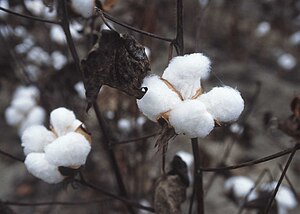
Once Valledupar's main economic produce; Cotton

Cotton is a hygroscopic material , hence it easily adopts to the atmospheric airconditions. Air temperature inside the mixing and blowroom area should be more than 25 degree centigrade and the relative humidity(RH%) should be around 45 to 60 %, because high moisture in the fibre leads to poor cleaning and dryness in the  fibre leads to fibre damages which ultimately reduces the spinnability of cotton.

Cotton is a natural fibre. The following properties vary very much between bales (between fibres) fibre micronaire fibre length fibre strength fibre color fibre maturity   Out of these , fibre micronaire, color, maturity and the origin of growth results in dye absorption variation.
There fore it is a good practice to check the maturity , color and micronaire of all the bales and to maintain the following to avoid dye pick up variation and barre in the finished fabric.
BALE MANAGEMENT :
Bale Management
In a particular lot
  • Micronaire range of the cotton bales   used should be same for all the mixings of a lot
  • Micronaire average of the cotton bales used should be same for all the mixings of a lot
  • Range of color of cotton bales used should be same for all the mixings of a lot
  • Average of color of cotton bales used should be same for all the mixings of a lot
  • Range of matutrity coefficient of cotton bales used should be same for all mixings of a lot
  • Average of maturity coefficient of cotton bales used should be same for all mixings of a lot
Please note, In practice people do not consider maturity coefficient since Micronaire variation and maturity variation are related to each other for a particular cotton.
It the cotton received is from different ginners, it is better to maintain the percentage of cotton from different ginners throught the lot, even though the type of cotton is same.
It is not advisable to mix the yarn made of out of two different shipments  of same cotton. For example , the first shipment of west african cotton is in january and the second shipment is in march, it is not advisable to mix the yarn made out of these two different shipments.  If there is no shadevariation after dyeing, then it can be mixed.
According to me, stack mixing is the best way of doing the mixing compared to using automatic bale openers which picks up the material from 40 to 70 bales depending on the length of the machine and bale size, provided  stack mixing is done perfectly. Improper stack mixing will lead to BARRE or SHADE VARIATION  problem.  Stack mixing with Bale opener takes care of short term blending and two mixers in series takes care of long term blending.
why?
  • Tuft sizes can be as low as 10 grams and it is the best way of opening the material(nep creation will be less, care has to be taken to reduce recyling in the inclined lattice)
  • contaminations can be removed before mixing is made
  • The raw material  gets   acclamatised to the required temp and R.H.%, since it is allowed to stay in the room for more than 24 hours and the fibre is opened , the fibre gets conditioned well.
Disadvantages:
  • more labour is required
  • more space is required
  • mixing may not be 100% homogeneous( can be overcome by installing double mixers)
If automatic bale opening machine is used the bales should be arranged as follows:
let us assume that there are five different micronaires and five different colors in the mixing, 50 bales are used in the mxing. 5 to 10 groups should be made by grouping the bales in a mixing so that each group will have average micronaire and average color as that of the overall mixing. The position of a bale for micronaire and color should be fixed for the group and it should repeat in the same order for all the groups
It is always advisable to use a mixing with very low Micronaire range.Preferably .6 to 1.0 . Because:
  • It is easy to optimise the process parameters in blow room and cards
  • drafting faults will be less
  • dyed cloth appearance will be better because of uniform dye pickup etc
It is advisable to use single cotton in a mixing , provided the length, strength micronaire ,maturity coefficient and trash content of the cotton will be suitable for producing the required counts.  Automatic bale opener is a must if more than two cottons are used in the mixing, to avoid BARRE or SHADE VARIATION problem.
It is better to avoid  using the following cottons:
  • cottons with inseparable trash (very small size), even though the trash % is less
  • sticky cotton (with honey dew or sugar)
  • cotton with low maturity co-efficient
Stickiness of cotton consists of two major causes. Honeydew from Whiteflies and aphids and high level of natural plant sugars. The problems with the randomly distributed honey dew contamination often results in  costly production interruptions and requires immediate action often as severe as discontinuing the use of contaminated cottons.An effective way to control cotton   stickiness in processing is to blend sticky and non-sticky cotton.  Sticky cotton percentage should be less than 25%.

Sewing Machine Types

Deutsch: Nähmaschinenmechanismus. English: An ...

Sewing is a creative and interesting skill. The knowledge of sewing give a confident feeling when it is applied to the construction of garments. The earlier method of sewing by hand is not applicable for all stages of garment making. Therefore, considerable emphasis is given to machine sewing. There are several machines in the market today, each with its own desirable features and advantages. Sewing machines range from most basic having only simple lock stitch to the electronic machines that use advanced computer technology having various functions for example piping, binding, ruffling, pleating, darning, hemming and even making buttonholes and attaching fasteners. A good sewing machine is required to obtain quality products. One has to be familiar with the characteristics of different types of machines for selecting appropriate machine, depending upon the ability and requirements of the person.

TYPES OF SEWING MACHINES:
Sewing machines are now available in various models such as domestic model, tailor model, industrial model, portable and cabinet models. They may be operated by hand, treadle or electric motor.
Hand – Operated Sewing Machine:
This is the simplest form of sewing machine which is operated by hand. A detachable handle provided to the flywheel is used to operate the machine. This machine is generally suitable for domestic purpose because it does not help in speeding up the work.
Treadle Sewing Machine:
This machine is exactly like the hand sewing machine but it is operated by foot using an additional stand. In this type the balance wheel is operated by a belt with the help of lower stand, which is driven by feet. This machine operates faster than that of the hand-operated machine. This machine is suitable where there is no power supply. When handling
this machine both the hands are free to handle the fabric, speeding up the work. Even some of the heavy-duty machines are operated by this method.
Electric Sewing Machine:
This is the fastest sewing machine. One needs practice to handle it. In an electric machine the balance wheel comes to motion by a belt, which is attached to an electric motor.
PARTS OF A SEWING MACHINE AND THEIR FUNCTIONS:
The basic structure of sewing machine is the same whether it is hand-operated sewing, treadle sewing machine or electric sewing machine. The basic parts of a sewing are listed below and seen in Fig.1
image
1. Spool pin: It is fitted on top of the arm to hold the reel.
2. Thread guide: It holds the thread in position from the spool to the needle.
3. Tension disc: The two concave discs put together with the convex sides facing each other. The thread passes between the two. The tension of the thread is adjusted by a spring and nut which increases or decreases pressure
4. Take up lever: It is a lever fitted to the body of the arm. Its up and down motion feeds the thread to the needle and tightens the loop formed by the shuttle.
5. Needle bar: This is a steel rod to hold the needle at one end with the help of a clamp. Its main function is to give motion to the needle.
6. Bobbin case: This moves into position to catch the top thread and form the stitch as the needle is lowered into the bobbin chamber.
7. Presser foot: It is fixed to the presser bar to hold the cloth firmly in position when lowered.
8. Presser foot lifter: A lever attached to the presser bar for raising and lowering the presser foot.
9. Stitch regulator: This controls the length of the stitch.
10. Bobbin winder: A simple mechanism used for winding thread on the bobbin.
11. Fly Wheel: When this is made to revolve, it works the mechanism of the motion
12. Clutch or Thumb Screw: This is in the center of the fly wheel and it engages and disengages the stitching mechanism.
13. Slide Plate: A rectangular plate, which facilitates the removal of the bobbin case without lifting the machine.
14. Needle Plate or Throat Plate: A semi-circular disc with a hole to allow the needle to pass through it.
15. Feed dog: This consists of a set of teeth fitted below the needle plate. It helps to move the cloth forward while sewing.
16. Face plate: A cover which on removal gives access to the oiling points on the needle bar, presser bar and take-up lever.
17. Spool pin for bobbin winding: Spool of thread is placed on this at the time of bobbin winding.
PREPARATION FOR STITCHING:
Before starting actual machining, you should check that the needle of the machine is of correct size, is sharp and correctly set. The bobbin should be evenly set. Briefly, the various steps of prepreparation are:
• Winding the bobbin
• Upper Threading
• Drawing the bobbin thread
• Tension adjustments
• Pressure and feed adjustments
• Selection of thread and needle
A perfect stitch can be obtained only when the thread selected is suitable to the material to be stitched and the needle is of the correct size. For stitching on delicate thin fabrics, use fine thread and fine needle. For heavy fabrics, needles and thread size should be larger. The following Table 1 will be a guide to help selection of appropriate needle and thread sizes.
image
Types of Threads:
The natural fibre threads available in the market are cotton and silk. Synthetic threads are usually made from polyester and terylene. Threads whether natural or synthetic are produced in various thickness: higher the number, finer is the thread and smaller the number, coarser is the thread. It is important to remember that the same thread should be used for the bobbin and top spool.
Selection of needles:
Machine needles are selected according to the weight and other characteristics of the fabric, as well as the thread type being used for construction. Generally, a needle should be fine enough to penetrate the fabric without damaging it and yet have an eye, which is big enough so that the thread does not fray or break. Needles come in various sizes, from very fine (size 9) for light weight fabrics to thick (size 18) for very heavy weight and dense fabrics.
COMMON MACHINE TROUBLES:
The sewing like any other machine, gives troubles of stitching like thread breaking, uneven stitching, puckering, bending and breaking of needle, looping of threads, skipping of stitches, etc. Little problems with the sewing machine can be very irritating and time consuming. They can happen to even the most experienced seamstress. A person operating the machine should be able to rectify these and solve the problems. Some of the common machine problems are listed below:
• breaking needles
• looping of stitches
• skipping stitches
• variation in stitch length
• puckered seams
• upper thread breaking
• lower thread breaking
• machine not feeding properly
• machine working heavily
• layers feed unevenly
• fabric does not feed in straight line
• cause damage to fabric
• Puckering on both layers of fabric
• Puckering on under layer only
• Shows feed marks on the under side
• Fabric is damaged or holes around the stitches
CARE AND USE OF SEWING MACHINES:
A sewing machine needs care for its smooth running. It should be cleaned and oiled regularly to ensure satisfactory sewing and long life. When not in use, your machine should be covered to prevent dust accumulation on it. Use a small dry brush or old toothbrush and soft cloth to remove dust and lint. You should always remove lint deposits, dust and thread bits before oiling any part of the machine. Use a pointed instrument like a needle to pick out the bits of thread and lint that cannot be brushed out.
It is necessary to oil and lubricate the machine periodically. If the machine is used everyday, oil it once a week. After oiling, wipe off the surplus oil and place a piece of folded fabric under the presser foot to absorb any excess oil. To oil thoroughly, remove the upper thread, needle plate, slide plate, face plate, bobbin case, needle and presser foot. Oil the holes on the underside first, after cleaning and then proceed to the upper side. Use only few drops of oil in each hole. Never use coconut oil. Machine oil of different brands may be used for different models of sewing machine, but should be used as recommended in the instruction book.
If the machine becomes gummed with oil, put a drop of kerosene or petrol in each oil hole and joints and run it rapidly for several minutes. Wipe off and re-oil it with machine oil. The motor of electric sewing machine should be greased periodically.
Summary:The knowledge of sewing give a confident feeling when it is applied to the construction of garments. The various parts of a sewing machine and their functions helps one  to understand the working of a sewing machine. A brief up on the common machine problems help us to understand and rectify the problems. Above all the care of sewing
machine is rather important for a long service of the machine.

FLAX

Introduction:
Flax is used most largely in our textile manufactures. The linen fiber consists of the bast cells of certain species of flax grown in Europe, Africa, and the United States. All bast fibers are obtained near the outer surface of the plant stems. The pith and woody tissues are of no value. The flax plant is an annual and to obtain the best fibers it must be gathered before it is fully ripe. To obtain seed from which the best quality of linseed oil can be made it is usually necessary to sacrifice the quality of the fibers to some extent.

Treatment of Flax:
Unlike cotton, flax is contaminated by impurities from which it must be freed before it can be woven into cloth. The first process to which the freshly pulled flax is submitted is that of “rippling” or the removal of the seed capsules. Retting, next in order, is the most important operation. This is done to remove the substances which bind the bast fibers to each other and to remove the fiber from the central woody portion of the stem. This consists of steeping the stalks in water.
  • Retting:
(1) Cold water retting, either running or stagnant water.
(2) Dew retting.
(3) Warm water retting.
image
RETTING TANK
A—Inlet; B—Undisturbed Water; C—Bundles of Flax.
Cold water retting in running water is practiced in Belgium. Retting in stagnant water is the method usually employed in Ireland and Russia. The retting in stagnant water is more rapidly done, but there is danger of over-retting on account of the organic matter retained in the water which favours fermentation. In this case the fiber is weakened.
image
RETTING FLAX IN THE RIVER LYS, BELGIUM
image
FIBERS OF FLAX
In dew retting, the flax is spread on the field and exposed to the action of the weather for several weeks without any previous steeping. This method of retting is practiced in Germany and Russia. Warm water retting and chemical retting have met with limited success.
When the retting is complete, the flax is set up in sheaves to dry. The next operations consist of “breaking,” “scutching,” and “hackling” and are now done by machinery.
Breaking removes the woody center from the retted and dried flax by being passed through a series of fluted rollers. The particles of woody matter adhering to the fibers are detached by scutching.
  • Hackling:
Hackling or combing still further separates the fibers into their finest filaments—”line” and “tow.” The “flax line” is the long and valuable fiber; the tow, the short coarse tangled fiber which is spun and used for weaving coarse linen.
image
FLAX
A, Unthrashed Straw; B, Retted; C, Cleaned or Scutched; D, Hackled or Dressed.
image
HACKLING FLAX BY HAND
The “Tow” Is Seen at the Left and a Bunch of “Flax line” on the Bench.

  • Characteristics of Linen:
When freed from all impurities the chief physical characteristics of flax are its snowy whiteness, silky luster and great tenacity. The individual fibers may [Pg 50]be from ten to twelve inches in length; they are much greater in diameter than cotton. It is less pliant and elastic than cotton and bleaches and dyes less readily. Linen cloth is a better conductor of heat than cotton and clothing made from it is cooler. When pure, it is, like cotton, nearly pure cellulose.
  • Ramie:
Besides the linen, there is a great number of bast fibers fit for textile purposes, some superior, some inferior. India alone has over three hundred plants that are fiber yielding. One-third of these furnish useful fibers for cordage and fabrics. The next in importance to linen is ramie or rhea, and China grass. China grass comes from a different plant but is about the same as ramie. The staple is longer and finer than linen. The great strength of yarn made from it is due to length of the staple.
The variety and great value of the ramie fibers has long been recognized, but difficulties attending the separation and degumming of the fibers have prevented its employment in the manufactures to any great extent. The native Chinese split and scrape the plant stems, steeping them in water. The common retting process used for flax is not effective on account of the large amount of gummy matter, and although easy to bleach it is difficult to dye in full bright shades without injuring the luster of the fibers.
  • Jute and Hemp:
Jute and hemp belong to the lower order of bast fibers. The fiber is large and is unfit for any but the coarsest kind of fabrics. Jute is mainly cultivated in Bengal. The fiber is  separated from the plant by retting, beating, etc.
image
JUTE GROWING IN LOUISIANA.
image
DRYING HEMP IN KENTUCKY
  • Olona:
Olona, the textile fiber of Hawaii, is found to have promising qualities. This plant resembles ramie and belongs to the nettle family also, but it is without the troublesome resin of the ramie. The fiber is fine, light, strong, and durable.
The Philippines are rich in fiber producing plants. The manila hemp is the most prominent, of which coarse cloth is woven, besides the valuable cordage. The sisal hemp, pineapple, yucca, and a number of fiber plants growing in the southern part of the United States are worthy of note. These fiber industries are conducted in a rude way, the fiber being cleaned by hand, except the pineapple

Short Staple Processing

Yarns are continuous strands of fibers that can be woven or knitted into fabrics. The term, “spinning” refers both to the final yarn-making operation that puts a twist in the yarn and also to the entire sequence of operations that convert raw fibers into usable yarns. Yarn making from staple fibers involves picking (opening, sorting, cleaning, blending), carding and combing (separating and aligning), drawing (re-blending), drafting (drawing into a long strand) and spinning (further drawing and twisting)3. Silk and synthetic filaments are produced by a less extensive procedure. Current high-production yarn-making operations are performed on integrated machines that perform this entire sequence as one combined operation.

Picking (Including Opening and Blending):
Includes the separation of the raw fibers from unwanted material: leaves, twigs, dirt, any remaining seeds, and other foreign items. The fibers are first blended with fibers from different lots or other sources to provide uniformity. (They also may be blended with different fibers to provide improved properties in the final fabric.) When cotton fibers are processed, the raw cotton is run through a cotton ginning operation and then undergoes a cleaning sequence before it is pressed into rectangular bales for shipment to the textile mill. There, the picking starts with a blending machine operation. Bales are opened and cotton from several lots is fed to the machine. The cotton then proceeds to an opening machine that opens tufts of cotton with spiked teeth that pull the fibers apart. Up to three stages of picking follow, after which the cotton is often in the form of a lay, a roll of cotton fiber about 40 in (1 m) wide, 1 n (25 mm) thick and weighing about 40 lb. (18 kg)1. Figs. 1a, 1b and 1c show the lending, opening and picking operations.
Figure 1a: Blending and feeding cotton fibers. Cotton from bales (1), is dropped onto an apron conveyor (2), and moves to another apron conveyor (3), whose surface is covered with spikes. The spikes carry the cotton upward where some of it is knocked off by a ribbed roller(4). The cotton knocked back mixes with cotton carried by the spiked apron. Cotton that passes the knock-back roller is stripped off by another roll (5) and falls (6) to a conveyor that carries it to the next operation. (Illustration used with permission, Dan River Inc.).
image
Figure 1b: Opening cotton fibers—Cotton from the blending operation falls on an apron conveyor (1) and passes between feeder rolls (2) to a beater cylinder (3). The beater cylinder has rapidly rotating blades that take small tufts of cotton from the feeder rolls, loosen the bunches, remove trash, and move the cotton to the pair of screen rolls (4). The surfaces of these rolls are covered with a screen material. Air is drawn through the screens by a fan (5),pulling the cotton against the screens and forming a web. Small rolls (6), pull the cotton from the screen rolls and deposit it on another conveyor (7), that carries it to another beater (8), that removes more trash. The cotton then moves to the picker operation. (Illustration used with permission, Dan River Inc.)
image
Figure 1c: Picking cotton fibers—Cotton from the opening operation falls on an apron conveyor (1) which moves it to the first of a series of beaters (2), and screen rolls (3). The beaters and screen rolls in the series are all similar but are progressively more refined as the bottom moves through the equipment. Each beater removes more trash from the cotton. When it reaches the output section (4), the cotton is in the form of a web or lap that is wound into lap roll (5) by winding rolls (6). The lap roll in then ready to be transported to the carding equipment. (Illustration used with permission, Dan River Inc.)

Carding:
Is a process similar to combing and brushing. It disentangles bunches and locks of fibers and arranges them in a parallel direction. It also further eliminates burrs and other foreign materials and fibers that are too short. The operation is performed on cotton, wool, waste silk,and synthetic staple fibers by a carding machine that consists of a moving conveyor belt with fine wire brushes and a revolving cylinder, also with fine wire hooks or brushes. The fibers from the picking operation are called “picker lap”, and are fed between the belt and the cylinder whose motions pull the fibers in the same direction to form a thin web. The web is
fed into a funnel-like tube that forms it into a round rope-like body about 3/4 in (2 cm) in diameter. This is called a sliver or card sliver. The carding operation is illustrated in Fig.
image
Figure:Carding cotton fibers—The lap (1) from the picking operation is unrolled and fed by the feed roll (2), to the lickerin roll (3), which has wire shaped like saw teeth. The lickerin roll moves the lap against cleaner bars (4), that remove trash, and passes it to the large cylinder (5). The surface of the large cylinder holds the cotton with thousands of fine wires.The flats (6), with more fine wires, move in the direction opposite to that of the large cylinder.The cotton remains on the large cylinder until it reaches the doffer cylinder (7), which removes it from the large cylinder. A doffer comb (8), vibrates against the doffer cylinder and removes the cotton from it. The cotton, in a filmy web, passes through condenser rolls (9),and into a can through a coiler head (10). The subsequent operation is either combing or drawing. (Illustration used with permission, Dan River Inc.)

Combing:
Is an additional fiber alignment operation performed on very fine yarns intended for finer fabrics. (Inexpensive and coarser fabrics are made from slivers processed without this further refining.) Fine-tooth combs are applied to the sliver from carding, separating out the shorter fibers, called noils, and aligning the longer fibers to a higher level of parallelism. The resulting strand is called a comb sliver. With its long fibers, the comb sliver provides a smoother, more even yarn.

Drawing (Drafting), (Re-Blending):
After carding and, if performed, combing, several slivers are combined into one strand that is drawn to be longer and thinner. Drawing frames have several pairs of rollers through which he slivers pass. Each successive pair of rollers runs at a higher speed than the preceding pairso that the sliver is pulled longer and thinner as it moves through the drawing frame. The operation is repeated through several stages. The drawing operations produce a product called roving which has less irregularities than the original sliver. Afterward, the finer sliver is given a slight twist and is wound on bobbins. Fig. 10B4 illustrates the drawing operation.Figure
image
Figure : Drawing—Cans (1), filled with slivers from the carding operation, feed the slivers to the drawing frame. The slivers pass through spoons (2), that guide the slivers and stop the equipment if any should break. The rollers (3), turn successively faster as the slivers move through them, reducing the size of the slivers and increasing their length approximately six fold. At this point, the slivers are combined into one which is deposited into a can (4), by coiler head. The sliver fibers are much more parallel, and the combined sliver is much more uniform after the operation, which is usually repeated for further improvement of the cotton slivers. (Based on an illustration from Dan River, Inc. Used with permission.)

Spinning (Twisting):
Further draws out and twists fibers to join them together in a continuous yarn or thread. The work is performed on a spinning frame after drawing. The twist is important in providing sufficient strength to the yarn because twisting causes the filaments to interlock further with one another. The roving passes first through another set of drafting rolls, resulting in lengthened yarn of the desired thickness.
There are three kinds of spinning frames: ring spinning, open-end (rotor) spinning, and air-jet spinning. With the common ring spinner, the lengthened yarn is fed onto a bobbin or spool on rotating spindle. The winding is controlled by a traveller feed that moves on a ring around the spindle but at a slower speed than that of the spindle. The result is a twisting of the yarn.The yarn guide oscillates axially during winding to distribute the yarn neatly on the bobbin.The yarn can then be used to weave or knit textile fabrics or to make thread, cord or rope.Staple yarns, made from shorter fibers require more twist to provide a sufficiently strong yarn;filaments have less need to be tightly twisted. For any fiber, yarns with a smaller amount of twist produce fabrics with a softer surface; yarns with considerable twist, hard-twisted yarns,provide a fabric with a more wear resistant surface and better resistance to wrinkles and dirt,but with a greater tendency to shrinkage. Hosiery and crepe fabrics are made from hard twisted
yarns. Fig.  illustrates ring spinning.
image
Figure : Ring spinning. Spun sliver from the drawing operations, which is then called roving, and is wound on bobbins (1), and is fed through another series of drawing rollers (2),that further draw the strand to its final desired thickness. A larger bobbin (4) on a rotating spindle (3), turns at a constant speed. The speed of the final pair of drawing rollers is set a the speed that delivers the yarn so that it is twisted by the desired amount as it is wound on the bobbin. The yarn is guided by the traveller (5), which slides around the bobbin on the ring (6).Because of some drag on the traveller, the yarn winds on the bobbin at the same rate of speed as it is delivered by the final pair of rollers. (Illustration used with permission, Dan RiverInc.)

Spinning Synthetic Fibers:
The term “spinning” is also used to refer to the extrusion process of making synthetic fibbers forcing a liquid or semi-liquid polymer (or modified polymer, e.g., rayon) through small holes in an extrusion die, called a spinneret, and then cooling, drying or coagulating the resulting filaments. The fibers are then drawn to a greater length to align the molecules. This increases their strength. The monofilament fibres may be used directly as-is, or may be cut into shorter lengths, crimped into irregular shapes and spun with methods similar to thoseused with natural fibers. These steps are taken to give the synthetic yarns the same feel and
appearance as natural yarns when they are made into thread, garments and other textile products. (Section A2, above, describes wet and dry spinning methods of making rayon and acetate fibers.

Compact Spinning for Improved Quality of Ring-Spun Yarns

Abstract:
A new impulse in the field of ring spinning technology is offered by compact-condensed spinning. The article presents the comparison of two chosen spinning systems for the production of compact ring yarns. We have analysed and compared the physical, mechanical and morphological properties of conventional and compact yarns, spun at the same technological and kinematical parameters from the same cotton, cotton/PES and cotton/viscose roving. The construction specificities of the Suessen and Zinser compact ring spinning frames, on which the comparative spinning was performed, are described within this work. The purpose of the study was to determine the influence of differences in compacting systems on yarn quality, and to compare the compact and conventional yarns produced.


Key words: 
ring spinning, compact spinning, compact yarns, physical/mechanical properties of yarns.

Introduction and Motivations:
In spite of modernisation and rapid technological development in the field of ring spinning, the mechanism ring-traveller spindle has remained almost the same until now. Furthermore, ring spinning remains the dominant spinning technology even today. The producers of modern spinning frames have been developing the machines with improved construction of different working elements and optimal spinning geometry, with a ring diameter of 36 mm, a tube length of 180 mm and spindle speed of up to 25,000 min-1. All serving and transport functions have already been automated. A high linking level of spinning and winding, and even of the winding and twisting technological processes, has been achieved using the elements of computer-assisted automation and control. Besides the conventional functions (spindle speed, delivery speed, productivity, twist, draft, machine efficiency), computer-based systems control and enable the optimisation of spinning conditions (formation of bobbins, position of ring rail, automated doffing and setting of empty tubes, cleaning and oiling of main machine parts). Construction improvements of different working elements of the ring-spinning frame and optimised spinning geometry of the continuous form of fibres (roving or sliver) enable increased productivity, better yarn quality, as well as flexibility and profitability of the process.
All these optimisations and improvements of the ring spinning frame, however, have not enabled the reduction of the spinning triangle, which can be defined
as the most problematic and weakest spot in the yarn formation process using the ring-traveller system [1,2]. The spinning triangle that occurs while the yarn is formed is the cause of many fibres leaving the drafted roving, or being partly spun into the yarn with one end only. This causes greater waste of fibres, lower exploitation of fibre tenacity in yarn, poorer appearance and greater hairiness of the spun yarn. The newest research in the field of ring spinning has shown that modification of a three-cylinder drafting equipment with tow aprons in a region after front drafting rollers enables ring spinning to proceed with a minimised spinning triangle, or even without it at all. This modified process is called compact or condensed spinning [1,3,4].
The purpose of the study presented within this article was to produce, analyse and compare the yarns using two different systems for the production of compact and conventional ring yarns, offered by two well-known producers of ring spinning machines. In Predilnica Litija (Litija Spinning Mill), one of the Slovenian short-staple spinning mills, a need exists to modernise the existing ring spinning frames for medium-fine yarns produced from cotton fibres and blends consisting of cotton and chemical fibres, mainly PES and viscose. Today, the main goal of the company is to achieve improved yarn quality that will ensure better competitiveness and higher yarn prices. Therefore, a decision was made to compare the quality of conventional and compact yarns and (also taking into account the production costs), to explore whether the quality parameters of compact yarns had been improved significantly enough to justify the purchase of new machines, or the adaptation of drafting equipment of the existing ring spinning frames.
For this reason, it was decided to use the same roving with a linear density of 588 tex produced by the Litija Spinning Mill, and to produce a certain amount of yarns using the Suessen and Zinser ring spinning frames equipped with compact and conventional drafting systems under comparable technical and kinematical conditions.
The tests were directed and supervised by the leading technical personnel of the Litija Spinning Mill, together with the specialists of Suessen and Zinser workshop spinning mills, where the production of yarn samples was carried out over approximately the same time period. 20 kilograms of each yarn type (one compact and one conventional from each ring spinning machine producer) was produced in order to ensure sufficient yarn quantity for testing purposes. Yarn testing was done by both machine producers in the laboratories of Suessen and Zinser, using valid standard methods and procedures that guaranteed the statistical significance of test results. The information on yarn quality was then sent to the Litija Spinning Mill, where the data was analysed and compared.
Conventional Versus Compact Ring Spinning Technology:
The twist that is transmitted to the yarn in the ring spinning process originates along the curve between the traveller and front drafting rollers. Transmission of twists is opposite to the yarn movement in this area. The traveller transmits twists to already drafted fibres as close as possible to the clamping point after the front rollers. However, the twists never reach the clamping point, because after leaving the front rollers the fibres tend to direct towards yarn axis. The different length of the path of the inner and outer fibres that form the yarn cause a so-called spinning triangle in ring spinning [5]. The length of the spinning triangle depends on spinning geometry and twisting intensity [6,7]. The form and dimensions of the spinning triangle significantly influence the structure, surface characteristics, physical and mechanical characteristics of spun yarn. Not all fibres that are placed at the external edges of the triangle can be spun into the yarn structure, and can leave the drafting equipment without having been spun into the yarn. Such fibres also increase yarn hairiness.
The gradual transmission of twists with the traveller along the yarn balloon causes a certain tension in the fibre bundle that forms the spinning triangle, a tension
which is not distributed symmetrically in the yarn cross section. It is greatest in fibres that are positioned at the edges of the spinning triangle, and smallest in fibres lying in the middle of the triangle. This asymmetric distribution is the reason for fibre breakage according to their position in the spinning triangle during subsequent processing [4,6,8,9]. Furthermore, the fibres gradually take over the external axial yarn loading; therefore, they also break one after another. The consequence is lower yarn strength and poorer utilisation of the fibre tenacity (35 to 50%).
Much has already been done to minimise the influence of the spinning triangle in the ring spinning process. Different mechanical devices such as condensers have been used in the past to retard the widening of the roving [10]. However, these measures were only partly successful. The length between the mechanical condenser in the main drafting area and clamping point between the front rollers was too long to ensure the condensing effect. As soon as the condensed fibre bundle left the mechanical condenser, the fibres were relaxed and again formed an undesirably wide fibre bundle.
Minimisation or even elimination of the spinning triangle, enables almost all fibres to be incorporated into the yarn structure with maximum possible length and pre-tension of the fibres, irrespective of their position in the spinning triangle. The uniform pre-tension of the majority of fibres enables more synchronic breakage of the majority of the fibres, which contributes to higher yarn strength and better utilisation of the fibre tenacity (from 65% up to even 80%).
All compact yarns, whether produced of short-staple fibres (cotton, cotton-type chemical fibres and their mixtures) or long-staple fibres (wool, wool-type chemical fibres and their mixtures) represent a whole new range of yarns as regards their quality and appearance. When compared with conventional ring-spun yarns, compact yarns have significantly higher tenacity and elongation, work to break, and abrasion resistance. In addition, their surface smoothness, elasticity and softness are much better thanks to the almost ideal structure of compact yarns. To achieve tenacity comparable with conventional ring-spun yarns, a lower number of turns per metre can be used, which enables higher productivity of the spinning machine, as well as better
elasticity and softer hand of different flat textile products.
The better use of the fibres’ tenacity in compact yarns enables the use of cheaper raw material. Yarn singeing is not required because of minimal secondary hairiness, caused by the fibres exceeding the length of 3 mm. One should also mention savings in the sizing process of up to 50% compared to the conventional yarns. In some cases, sizing is even not required [11]. Lower primary hairiness (hairs with a length of 1 to 2 mm) and significantly lower secondary hairiness (hairs with a length of 3 mm and more) result in less prominent pilling in yarns and in the finished textile products.
Lower yarn hairiness enables the production of flat textiles with better appearance and more explicit, sharp contours, for example in jacquard-woven and printed fabrics. When smooth surface, high gloss and durability of the end product is required, compact yarns should be used for production in spite of the slightly higher price. In spite of the difficult situation of the whole textile sector, there are still some spinning mills in Slovenia that continue production and successfully compete on the national and international markets. Most of them use conventional ring and rotor spinning [12]. The most successful yarn manufacturers are already testing different compact spinning machines and searching for the most appropriate way to modify the drafting equipments of their existing ring spinning machines.
Comparison of the Two Compacting Principles:
The drafting equipment of the Fiomax E1 compact spinning machine (Figure 1) consists of a pair of delivery rollers (1- 11), a double aprons area (2-21), a pair of front rollers (3-31) and a condensing zone (S1-S4). The condensing unit consists of a profile tube (S), the lattice apron (G) and the delivery top roller (4).
Regarding the configuration of the drafting unit (1-11) to (3-31), it is a standard three-cylinder system with two aprons, and enables the processing of a wide spectrum of raw materials. The tube (S) has a built-in slot in order to create negative pressure in the area (S1-S4). Drafted roving comes into the condensing field (S1-S4), where the fibres are condensed up to the clamping point (4-S4) consisting of the top roller (4) and sucking tube (S).
Picture
The delivery top roller (31) is connected with the top roller (4) by the gear wheel. The top rollers (31) and (4) are driven by the delivery drafting cylinder (3). Using friction, the top roller (4) drives the endless lattice apron, which slides over the profile tube (S) that is not moving. To guarantee a slight axial tension of fibres in the condensing zone (S1-S4), the roller diameter (4) is slightly larger than that of the top roller (31). In this way, a small drafting of fibre bundle is ensured in the condensing zone, which enables optimal axial tension and fibre orientation.
The profile tube (S) has a small slot in the area (S1-S4) and is closely embraced by a lattice apron. The porosity of the apron and the negative pressure in the slot area result in a condensed fibre bundle that is transported up to the zone (4-S4). The oriented fibres remain completely condensed and closed up to the delivery clamping and twist insertion line (4-S4) because of the slot length. Therefore, no spinning triangle is formed, which enables literally all the fibres to be wound into the yarn and optimal yarn structure. The slot in the profile tube (S) can be positioned in the direction of fibre movement or at an incline to the direction of fibre flow, for instance when processing shorter fibres, such as carded cotton. This ensures the firm incorporation of outer fibres into the yarn because of a transverse force on the fibre band during the fibre transport and the rotation of fibres around their axis. The lattice apron is made of the cotton fabric in plain weave, and has more than 3000 holes per square centimetre. The drafting unit of the Fiomax E1 spinning machine enables the fibres to stay condensed up to the clamping and twist insertion line, which results in a minimised spinning triangle. The result is spun yarn with maximum strength and minimal hairiness. Besides the condensing effect, a light tensioning of the fibre bundle during condensing is also crucial for this process.
The drafting equipment of the Zinser RM 700 spinning machine (Figure 2) consists of the standard three-cylinder drafting unit with two aprons (1-11-2-21-3-31) and condensing unit (4-41).
The top roller (41) is covered by the endless apron with a set of holes in the middle. The apron runs over the profile tube (H), which has a suction slot in the zone (H1-H2). The drafting unit construction in zones (1-11), (2-21) and (3-31) is a modern three-cylinder drafting system
that enables the processing of a wide range of fibre lengths. The final drafting occurs between the zones (2-21) and (3-31). The fibre bundle is condensed under suction on a perforated surface in the zone (H1-H2). In a short zone between (H2) and (4-41), the fibre bundle is not under suction and therefore loses some of its hitherto gained condensed form. Therefore, in the zone (4-41) the spinning triangle is not reduced to the minimum, which negatively influences the quality of spun yarn. This undesired effect is more obvious when processing shorter fibres. The suction slot is directed in the fibre bundle axis in the area (H 1- H2). It is not possible to set it under a certain incline regarding the fibre bundle axis. The drafting system construction enables light axial tension acting on fibres in a condensing zone between (3-31) and (4-41), which has a positive effect on increased adhesion between fibres that are incorporated into the yarn. The technological data of the Suessen and Zinser compact and conventional ring spinning machines used for production of yarn samples is given in Table 1.
Click to Enlarge
compact spinning.html_Picture4
compact spinning.html_Picture5
Direction of Yarn Samples’ Production and Raw Material Characteristics:
The production of yarn samples was directed and supervised by the leading technical personnel of the Litija Spinning Mill together with the specialists from Suessen and Zinser. Since we wanted to compare the compact and conventional yarns produced on at least two different spinning machines types, the production of yarn samples was carried out at the Suessen and Zinser workshop spinning mills at approximately the same time period. 20 kilograms (20 bobbins with roving) of each yarn type (one compact and one conventional from each ring spinning machine producer) was pro-
duced in order to ensure sufficient yarn quantity for testing purposes.
The following fibrous material was used for the production of yarn samples:
compact spinning.html_Picture3
A standard spinning preparation and modern machinery were used to produce the roving with a linear density of 588 tex from each fibre blend at the Litija Spin ning Mill using the same fibre lots fo each blend. After that, conventional and compact yarns with a linear density o 20 tex were produced under comparable technological and kinematical condition on the Suessen and Zinser ring spinning frames.
Quality Properties of Produced Yarns:
After production, the quality of yarns was tested in the laboratories of the Sues sen and Zinser machine producers, where the yarn samples were spun using valid standard methods and procedures tha guaranteed the statistical significance o test results. Ten bobbins of each compac and conventional yarn were tested. The information on yarn quality was then sent to the Litija Spinning Mill, where the data was analysed and compared. The following physical, mechanical and mor phological properties of the compact and conventional yarns produced were tested
and compared: real fineness, twist, breaking force, elongation at break and work to break, Uster properties, hairiness and length distribution of hairs on 100 m of a yarn. An Uster Tester 3 was used for testing the hairiness of the produced yarns. The results are given in Tables 2-4.

Discussion:
Based on the researched and compared mechanical, physical, morphological and Uster values of the conventional and compact ring yarns spun on the Zinser and Suessen spinning machines, the following conclusions can be drawn:
Properties of compared yarns made of 100% cotton fibres:
The breaking force of the compact yarn with a nominal linear density of 20 tex and spun on a Zinser ring spinning machine is 18.88% higher than the conventional ring spun yarn, produced on the same machine but without the condenser unit. The breaking force of the compact yarn spun on the Suessen ring spinning machine is up to 29.48% higher when compared with the conventional ring spun yarn, produced on the same machine but without the condenser unit. A higher difference in breaking force between the compact and conventional yarns produced on the Suessen ring spinning machine can be explained with the
construction of the drafting system that enables maximum fibre condensation all the way up to the clamping line, which is not the case in Zinser’s drafting system. A greater breaking force was measured in the yarn produced on the Zinser spinning machine.
Elongation at break of compact yarns is 7 to 8% higher compared to conventional yarns. The tenacity of a compact yarn produced on the Zinser spinning machine surpasses the conventional yarn by 17%, while this value is higher by up to 23.24% in the yarns spun on the Suessen spinning machine. A slightly higher value is noted in the yarn produced on the Zinser spinning machine.
The work to break of a compact yarn spun on a Zinser spinning machine is 21.82% higher than in conventional yarn. In the compact yarn produced on the Suessen spinning machine, the work to break is 32% higher than that of the conventional yarn. the higher absolute value of work to break was determined in the compact yarns produced on the Zinser spinning machine. The physical and mechanical properties of the compact and conventional yarns are represented in Figure 3.
No significant changes regarding Uster properties (Uster CV%, number of thin,
thick places and neps) in the conventional and compact yarns were determined. This can be explained by the use of the same three-cylinder drafting equipment, which is proven to be the major influence on these yarn properties.
The Uster hairiness (H) of compact yarns is significantly lower when compared with the hairiness of conventional yarns (Figure 4). Conventional ring spun yarn produced on the Suessen spinning machine has an Uster hairiness H=5.80, and the yarn spun on Zinser spinning machine has an Uster hairiness H=5.54. A lower value of Uster hairiness, H=3.80, was determined in compact yarn produced on the Suessen spinning machine, while that spun on the Zinser spinning machine has an Uster hairiness H=4.64. The reason for this is the construction of the drafting equipment, as explained above.
The morphology of the yarn, defined as the number of hairs of different length per 100 metres, shows the significantly lower primary hairiness (1 to 3 mm) and secondary hairiness (4 to 12 mm) of compact yarns. Better results and significant improvements were achieved with the Suessen spinning machine, which can also be explained by the special construction and elements of the drafting unit.
Properties of compared yarns made of 50% CO/50%PES fibre blend:
When comparing the physical and mechanical properties of conventional and compact yarns produced of 50% CO/50% PES fibre blend, we found no significant differences. This can be explained by the greater bending rigidity of polyester fibre component, which reduces the fibre condensing effect and its contribution to better physical and mechanical properties of compact yarns.
The analysed Uster properties of conventional and compact yarns are very similar, which confirms the fact that the condensing effect significantly influence neither the yarn irregularity nor the number of yarn faults.
The Uster hairiness (H) of compact yarns is significantly lower when compared with the hairiness of conventional yarns. A slightly better hairiness value was determined in yarn spun on the Zinser spinning machine (H=3.26) when compared with the yarn produced on the Suessen spinning machine (H=3.20).
The primary and secondary hairiness of a compact yarn made from this mixture
and spun on the Zinser spinning machine are better than in yarn produced on the Suessen ring spinning machine. Both compact yarns have significantly improved primary and secondary hairiness when compared with conventional ring yarns.
Properties of compared yarns made of 87% CO/13% CV fibre blend;
The breaking force of the compact yarn with a nominal linear density of 20 tex and spun on a Zinser ring spinning machine is 18.32% higher than the conventional ring spun yarn produced on the same machine but without the condenser unit. The breaking force of the compact yarn spun on the Suessen ring spinning machine is up to 32.30% higher than the conventional ring spun yarn produced on the same machine but without the condenser unit.
Elongation at break of compact yarns is 4 to 11 % higher compared to conventional yarns. The tenacity of a compact yarn produced on the Zinser spinning machine surpasses the conventional yarn by 15.90%, while this value is higher at up to 28.87% in yarns spun on the Suessen spinning machine. A higher absolute value of tenacity is determined in yarn produced on the Suessen spinning machine.
The work to break of a compact yarn spun on the Zinser spinning machine is 20.87% higher than in conventional yarn. In compact yarn produced on the Suessen spinning machine, the work to break is up to 41.88% higher compared to the conventional yarn. A slightly higher absolute value of Work to break was determined in compact yarns produced on the Suessen spinning machine.
The analysed Uster properties of conventional and compact yarns have very similar values. Conventional ring spun yarn produced on a Suessen spinning machine has an Uster hairiness of H=5.20, and the yarn spun on the Zinser spinning machine has an Uster hairiness of H=4.72. A lower value of Uster hairiness, H=3.40, was determined in compact yarn produced on the Suessen spinning machine, while the yarn spun on the Zinser spinning machine has an Uster hairiness of H=3.60, which can be explained by the inability of Zinser’s drafting system to keep thoroughly condensed fibres up to the clamping line. The Uster hairiness (H) of compact yarns is significantly lower when compared with the hairiness
of conventional yarns, irrespective of the machine system.
Both the primary and secondary hairiness of a compact yarn made of this fibre
blend and produced on the Zinser ring spinning machine are lower when compared with the yarn spun on the Suessen spinning machine. Both primary and secondary hairiness of compact yarns
Click to Enlarge
Picture
compact spinning.html_Picture8
are significantly lower than in conventional yarns, irrespective of the machine system. The improvement is more obvious when comparing conventional and compact yarns spun on the Suessen ring spinning machine, with or without a condenser unit.

Conclusions:
The aim of the study presented herein was to analyse and compare the yarns using two different systems for the production of compact and conventional ring yarns from the producers Suessen and Zinser. The same roving produced by the Litija Spinning Mill with a linear density of 588 tex was used to produce 20 kg of yarns from cotton, cotton/PES and cotton/viscose fibre blends under comparable technical and kinematical conditions. The tests were directed and supervised by the leading technical personnel of the Litija Spinning Mill together with the specialists of the Suessen and Zinser spinning mills, where the production of yarn samples was carried out over approximately the same time period. Yarn testing was carried out by both machine producers in laboratories using valid standard methods and procedures that
guaranteed the statistical significance of the test results. An analysis of results obtained within the comparative research into the quality properties of conventional and compact ring yarns produced at the Suessen and Zinser companies led to the following conclusions:compact spinning.html_Picture9
§ Compact yarns can be regarded as completely new ring spun yarn types as regards their morphological, physical and mechanical properties. With regard to fibre straightening, light axial tension and condensing of the fibrous bundle that form compact yarn, the new yarn structure can be defined as near-optimal.
§ The compact yarns have the following advantages when compared to the conventional ring yarns: significantly reduced primary and secondary hairiness, smooth surface, high gloss, improved mechanical and physical properties (with the exception of compact yarn produced from 50% CO/50% PES fibre blend), similar Uster properties, better resistance to rubbing, softer touch, and lower pilling effect in woven and knitted fabrics.
§ It is obvious that in the future compact yarns will be used as referential samples and benchmarks, based on which the quality of different types of spun yarn will be estimated.
§ Because of the numerous advantages of compact spinning, it can be assumed that the new spinning technique represents a promising impulse for ring spinning and spun yarn production.
§ If the spinning mills’ customers – producers of woven and knitted fabrics – require high quality spun yarns and are ready to pay approximately a 10% higher price for them (because of the higher cost of the compact ring spinning machine and the slightly higher energy costs), then the compact spinning has a promising future because of the higher production and improved quality of compact yarns.